

I wrote up an explanation of pulleys on Twitter last night in lieu of working on my job, which I’ve now been emboldened to share as a Substack post, because Carl Feynman just replied:
A really nice explanation. Reminds me of my dad explaining stuff to me.
So without further ado, please enjoy my Feynman-caliber masterwork of physics pedagogy. If you’re citing this post, please credit the author as Liron “Feynman” Shapira.
F***ing Pulleys
Everyone acts like it’s obvious that pulleys do a physically possible thing, but personally, I’ve never understood why you can lift a 100kg object straight up by pulling it with less force than what it weighs.
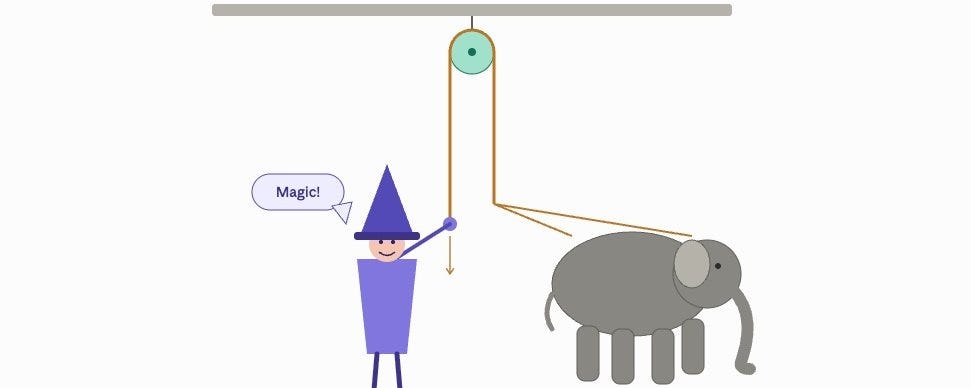
“Pulleys let you move the rope twice as far as the load moves, so you’re spreading your pull force over a 2x longer distance, so you can use 1/2 the force, it’s just conservation of energy!”
No, f*** you, that doesn’t explain why a wheel on the rope means I’m allowed to pull the rope half as hard to lift the same weight.
If you want to know the secret explanation I learned while procrastinating today, read on...
Ok imagine there’s a 100kg man lying in a hammock that has 2 supporting ropes. You’re on the left holding one rope, and there’s a tree on the right holding the other rope.
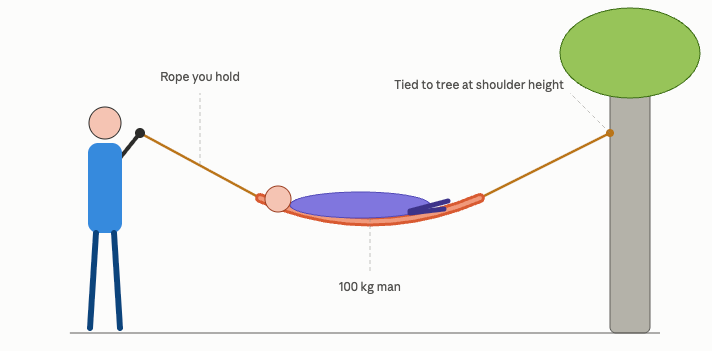
In this setup, you only lift 50kg of vertical weight, because you’re in a symmetrical configuration with the tree. Tada!
(That’s actually the trick to all “simple machines” — you take advantage of the fact that the ground/trees/etc are always game to lift or push against the full weight of objects, if the configuration provokes an equal & opposite reaction force.)
So yeah, you can lift the hammock a foot or two by lifting the rope over your head, and you’ll still only need ~half the lifting force you’d normally need for 100kg. Though note you have to raise your arms by 2ft to get the guy to lift 1ft, because the midpoint of the rope is the average height of your hands and the tree’s connection point, and the tree’s connection point hasn’t moved. I guess the “conservation of energy” guy was onto something there.
This simple hammock setup is a legit proof of concept of the core magic of the pulley. You’re just getting a tree or other fixed object to partner with you on bearing the weight of the lift. That’s it. It’s really quite simple, until the f*cking wheels get involved…
At this point, since our hammock proof of concept isn’t a genuine Pulley™, we have to deal with various little problems:
1. Puller’s configuration: Your arms aren’t long enough to pull much, or you have to keep walking toward higher ground as you pull
2. Rope needing to slide around the load: If the person in the hammock is attached to a fixed point on the rope (not spanning a bunch of width across it) and you try to pull up, you only have two options: (a) Pull straight up, but the tree’s half of the rope goes slack and now you’re pulling all 100kg, or (b) Treat the whole system as a pendulum/swing, giving it a very leftward-angled tug, which is a workable setup, but you lose the tree’s assistance as the hammock swings higher toward the horizontal configuration at the top of its arc. Realistically, you don’t want to attach the load to a fixed point on the rope. The rope needs to slide around the load as it lifts. Your friend is just going to have to accept getting rope burned.
3. Wasteful horizontal force component: The rope makes a V shape (as long as you’re not letting it go slack, which you can’t if you want to activate the tree’s component of lift), which means you have to add an additional wasted component of force pulling at the hammock (and the tree) horizontally. You can mitigate this issue if you stand right next to the tree and pull straight up, as long as the rope can slide relative to your load, but then problem 1 above becomes extra annoying — e.g. if you were hoping to walk your end of the rope up a ramp, it’s not going to be maximally efficient.
Alright, let’s add a wheel.
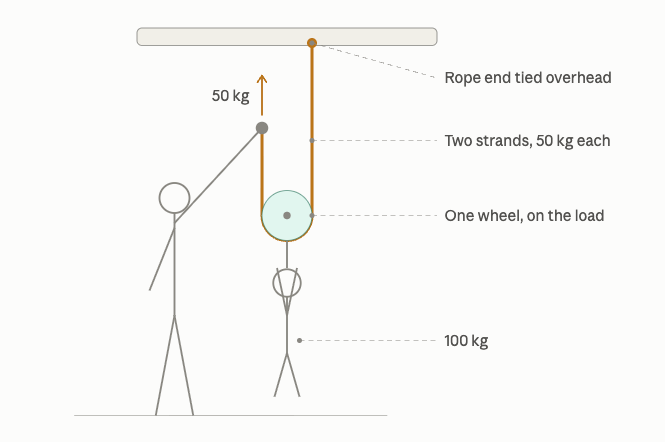
Now we’ve solved problems 2 and 3. The rope can easily slide around the load, keeping your friend’s upward journey smooth and balanced. And there’s no more wasteful horizontal force component — that’s not because of the wheel per se, it’s because you connected the rope to the ceiling.
And there’s no extra lift-force-easing magic here that the hammock setup didn’t already have. The load in this setup feels to you like 50kg because the ceiling plays the role of the tree from before, splitting the weight with you equally in a symmetrical configuration.
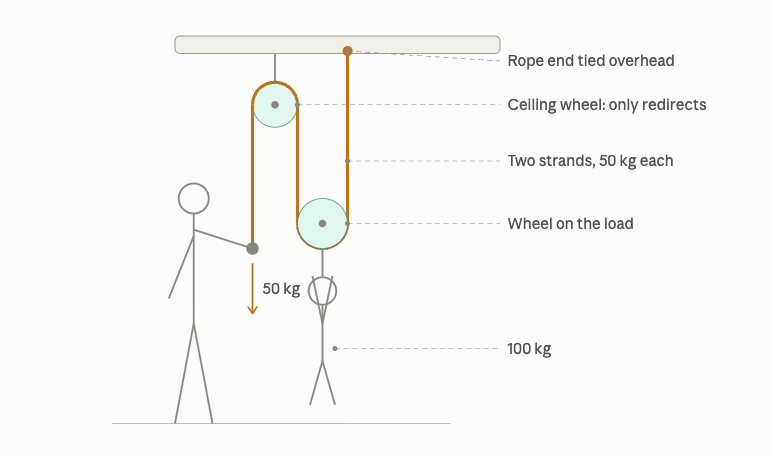
Finally, we’ll solve problem #1 by adding a second wheel, so now you can stand in the same place while you pull. The second wheel doesn’t do anything to the force, it just redirects the direction.
IMO the wheels are a shiny distraction. The hammock proof of concept is what it’s all about. Pulleys are just a way to use wheels to share the load with fixed objects like trees and ceilings.
In conclusion, f*** pulleys. But next time you see a hammock, consider impressing your friends with your efficient lifting abilities.
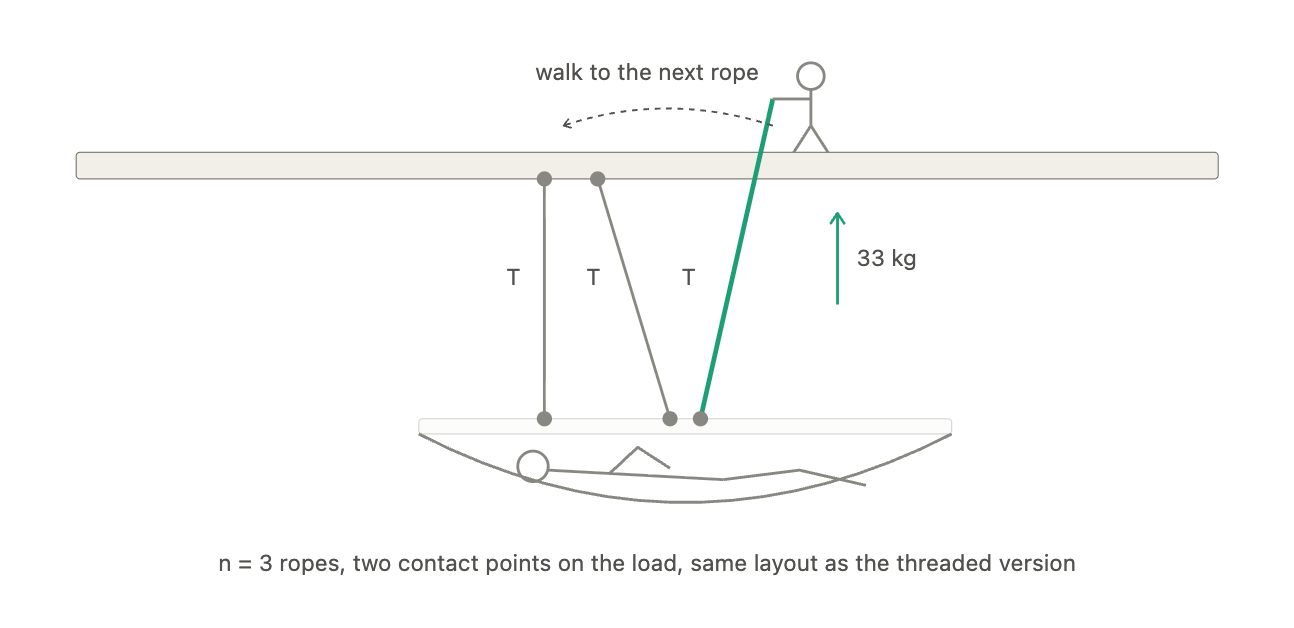
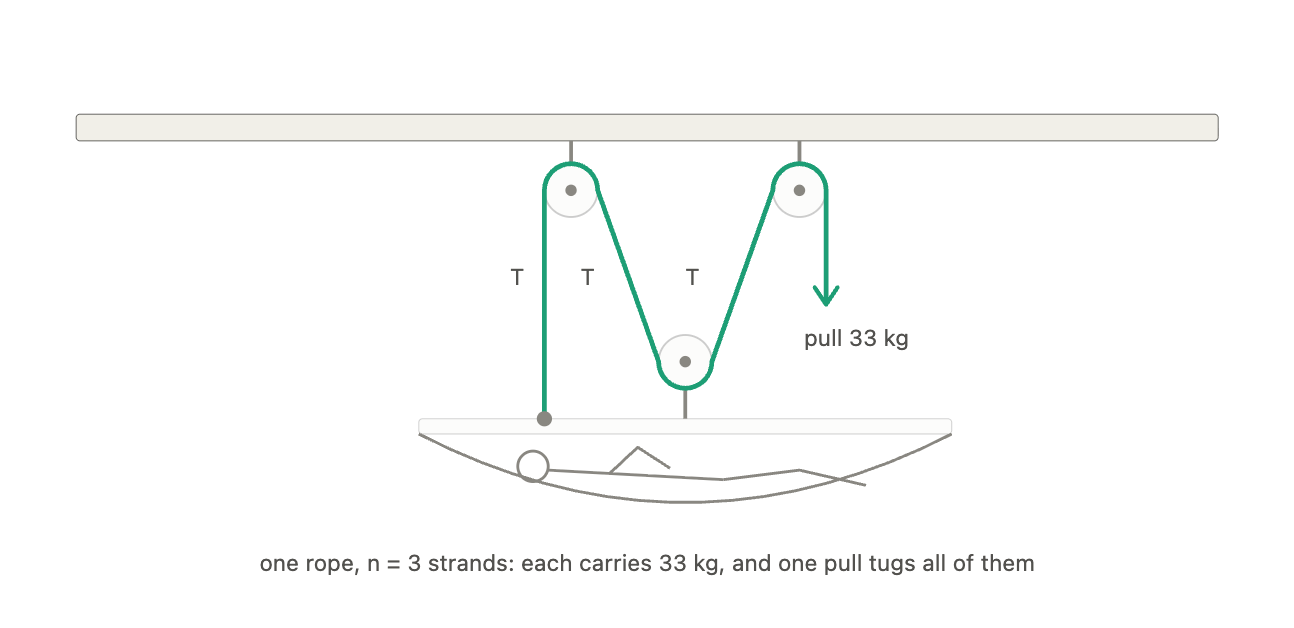
P.S. For fancier pulleys whose mechanical advantage is 3:1 or higher, the proof of concept is a hammock with 3 or more ropes that are all connected to the ceiling, except for one at a time that you hold. You can walk around the rafters pulling on one of the ropes at a time, with 1/3 or 1/n of your load’s full weight, by a small enough bit at a time that the other ropes still maintain their tension.
Then the upgrade you get by licensing the Pulley™ intellectual property is that a single long rope’s tension-spreading property makes the “pull on 3 sub-ropes in turn” process maximally efficient.
Liron “Feynman” Shapira is the host of Doom Debates, a show about disagreements that must be resolved before the world ends.
You sir are a bit silly.
By this logic, the true genius would be to tie both ends to the ceiling; and therefore you would need to carry 0 kg instead of 100kg....a total elimination of the force you are carrying. (Alternately, tie the end you are holding to the floor.) You don't actually need a pulley for any of your noted examples: a fixed rope would do the same job.
Pulleys deserve a better explanation, which I can provide briefly here. The benefit of a pulley is not the static holding of the rope at 50kg as a part of holding the 100kg total load. That comes with simply the use of two ropes and no pulley.
The benefit of the pulley is the raising of the entire load through a distance, from the floor upward, using less force than you'd otherwise need. And this distinction matters quite a bit; because it takes work (aka energy must be expended) to raise an object.
The pulley can provide that same energy, as you lift the hammock, by trading less force (50kg instead of 100kg) for more rope (to raise him 1m above the ground, you would have to pull a differential length of 2m of rope). Work = force times distance.
Better yet, add a 2nd pulley on the same axle as the first, on both the ceiling pulley and the object pulley, and run your rope from the ceiling back to the object and back to the ceiling before holding it. You just reduced the force to 25 pounds!... and now you'll need to pull 4x the rope length per distance of hammock-height. Etc., etc.
It is this reduction in force needed to actually move things; rather than holding them statically, that makes the pulley useful.
I love this genre of exploring how most of our understanding is so much more shallow than we realise. Feynman was a master at exposing this.
I’ve been meaning to write a piece on bikes. How they balance and why they need to be moving to stay balanced. Obvious, right?
Look out for an upcoming article entitled bikes or maybe if you prefer f**ing bikes.